Across Bridge, Cross-Chain Swaps and Intent Settlement
Across connects token bridging and cross-chain swaps through intents, orders that specify the desired destination token and amount. A bridge transfers an asset between supported chains; a swap changes the asset as part of that transfer. Applications can also attach destination contract calls. Available routes depend on the selected tokens, chains and execution method. Quotes identify the required input, output conditions and costs, while relayers and settlement infrastructure handle delivery and repayment.
Same-Asset Bridging and Cross-Chain Swaps
The desired destination asset determines whether a transfer needs a bridge alone or a route that includes a swap. Same-asset bridging suits a transfer that preserves the asset across networks. A cross-chain swap serves a different objective: receiving a different token on the destination chain. Depending on the supported route, conversion can occur before bridging, after bridging or on both sides. That distinction changes the relevant exchange rate, slippage conditions and final token that the recipient receives.
Embedded actions extend these transfers with a destination contract operation. Their availability depends on the chosen integration and destination.
Wallet Transactions, Gasless Submission and Deposit Addresses
The standard wallet path returns a transaction for the wallet to sign and submit, with token approvals when necessary. Across’s own interface and applications integrating its Swap API provide access to supported transfers. An application can expose a narrower selection than the protocol supports. Wallet balances, spending permissions and origin-chain gas govern whether a quoted transaction can proceed. Required approvals precede the main transaction; a quote alone moves no funds.
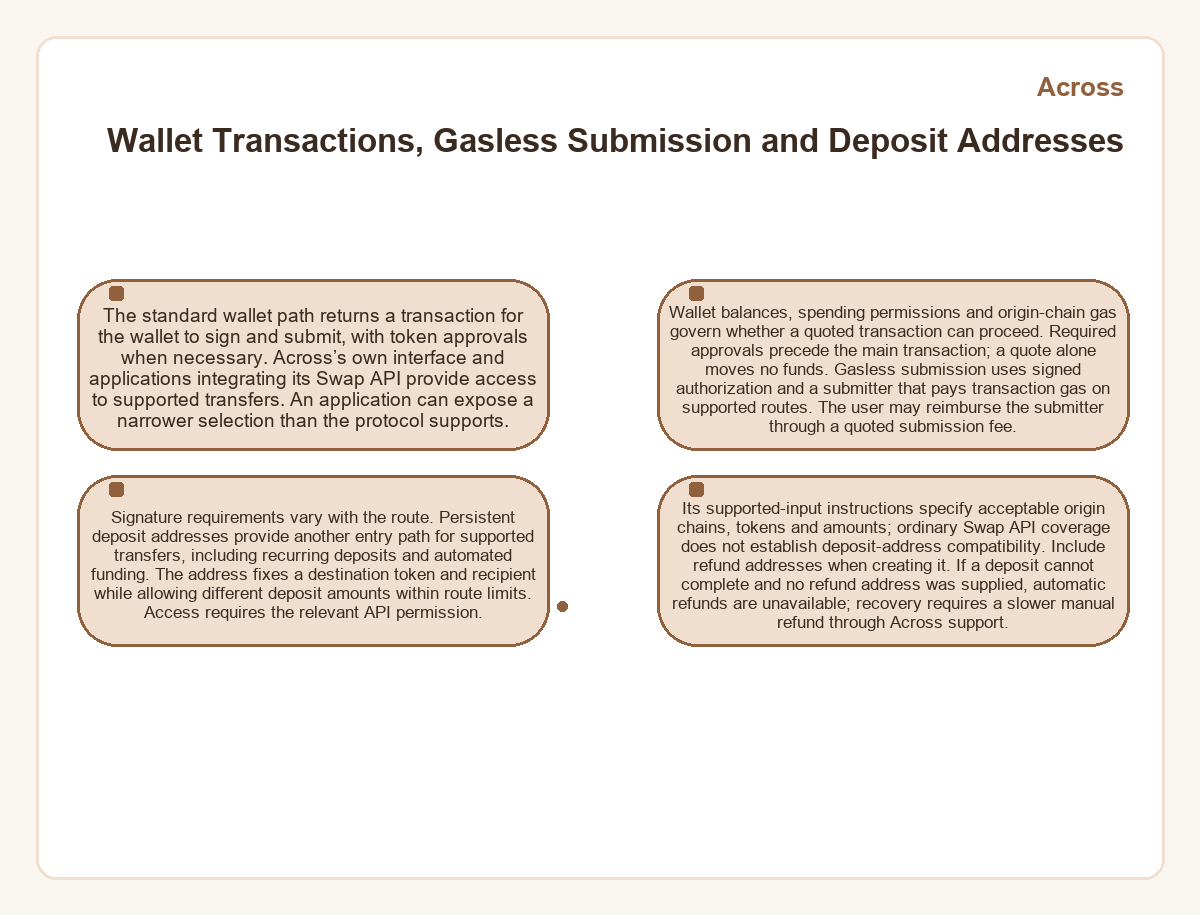
Gasless submission uses signed authorization and a submitter that pays transaction gas on supported routes. The user may reimburse the submitter through a quoted submission fee. Signature requirements vary with the route.
Persistent deposit addresses provide another entry path for supported transfers, including recurring deposits and automated funding. The address fixes a destination token and recipient while allowing different deposit amounts within route limits. Access requires the relevant API permission. Its supported-input instructions specify acceptable origin chains, tokens and amounts; ordinary Swap API coverage does not establish deposit-address compatibility. Include refund addresses when creating it. If a deposit cannot complete and no refund address was supplied, automatic refunds are unavailable; recovery requires a slower manual refund through Across support.
Quote Amounts and Output Conditions
The quote’s trade type determines whether the requested amount represents a fixed input, a minimum output or an exact output. Amounts belong to the specified token, with its own decimal precision. The response distinguishes expected output from minimum output, alongside any maximum input requirement. These values describe different constraints, so the expected receipt alone cannot express every trade’s acceptance condition.
Fixed Input
An
exactInput
request fixes the amount of the input token that the transfer spends. The quote calculates destination output after applicable costs. Insufficient input to cover fees prevents the request from succeeding.
Output Requirements
Output-led requests calculate the necessary input from the requested destination amount. The wallet must have enough funds for that input and applicable gas.
Minimum Receipt
A
minOutput
request sets a lower bound on destination output. A successful transfer can deliver more than that bound.
Exact Receipt
An
exactOutput
request asks for a precise destination amount. With strictTradeType enabled, the API rejects a request if the selected route cannot satisfy that mode. A destination contract that requires a fixed amount should receive a static argument; passing the entire available token balance can exceed that amount.
Relayer Costs, Pool Fees and Swap Impact
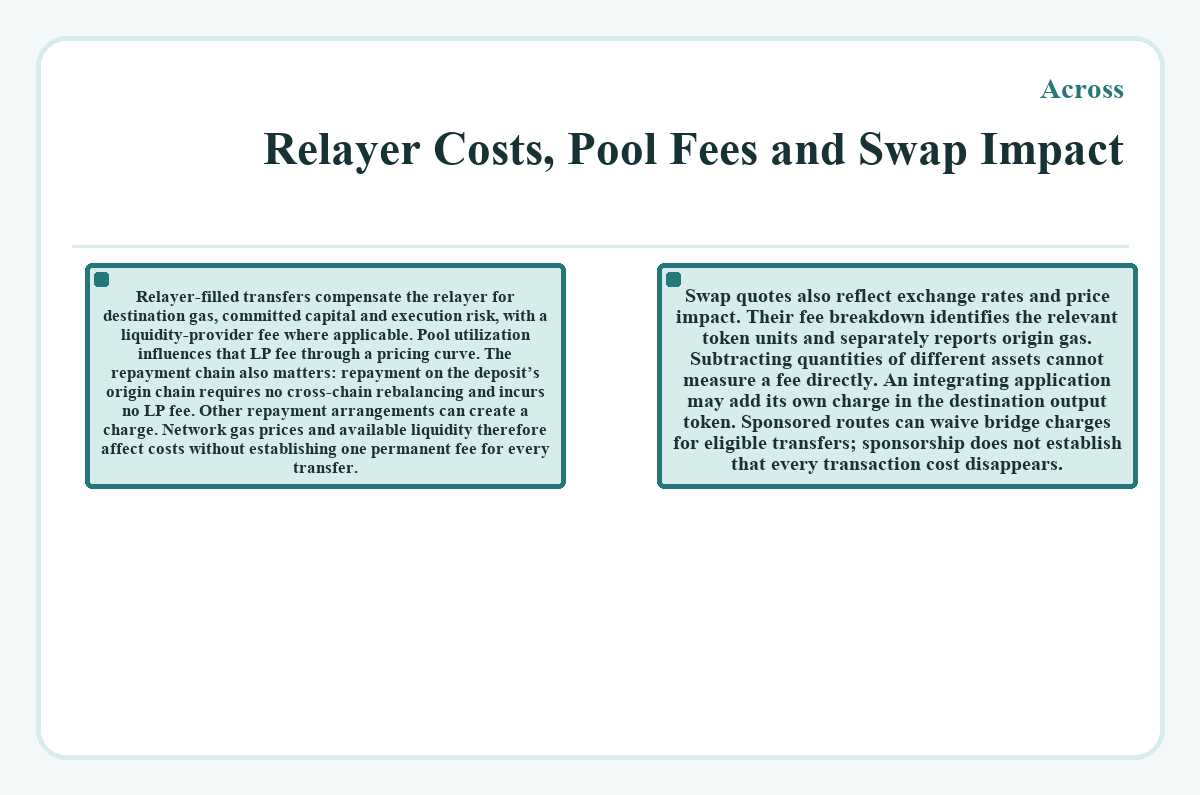
Relayer-filled transfers compensate the relayer for destination gas, committed capital and execution risk, with a liquidity-provider fee where applicable. Pool utilization influences that LP fee through a pricing curve. The repayment chain also matters: repayment on the deposit’s origin chain requires no cross-chain rebalancing and incurs no LP fee. Other repayment arrangements can create a charge. Network gas prices and available liquidity therefore affect costs without establishing one permanent fee for every transfer.
Swap quotes also reflect exchange rates and price impact. Their fee breakdown identifies the relevant token units and separately reports origin gas. Subtracting quantities of different assets cannot measure a fee directly. An integrating application may add its own charge in the destination output token. Sponsored routes can waive bridge charges for eligible transfers; sponsorship does not establish that every transaction cost disappears.
Intent Fills and Native Token Settlement
Across supports relayer-funded intents and token-specific settlement paths, with the selected quote identifying the mechanism for the requested route. Relayers use their own tokens to fill Across intents on the destination chain. Their inventory supplies the recipient before the protocol reimburses them. This separation makes the recipient’s delivery time different from the relayer’s repayment time. An available route still needs sufficient capital and workable execution conditions for its quoted amount.
Circle’s Cross-Chain Transfer Protocol, or CCTP, supports native USDC transfers through burning on the origin chain and minting on the destination. Across integrates CCTP settlement, and CCTP also supports protocol-level rebalancing behind relayer-filled USDC routes. Those roles differ: a rebalancing transfer moves protocol capital after a recipient’s fill, while a direct CCTP route uses burn-and-mint settlement for the user’s bridge leg.
OFT-based routes use LayerZero’s Omnichain Fungible Token model for supported assets such as USDT0. Token contracts and messaging govern those transfers. A token-specific path inherits different dependencies from an Across intent fill; support for one path does not establish every asset’s compatibility.
What Happens After a Relayer Delivers Tokens?
Settlement validates a filled intent and reimburses its relayer after the destination fill has delivered the promised tokens. The HubPool on Ethereum coordinates liquidity and settlement; SpokePools handle deposits and fills on supported chains. A dataworker aggregates valid activity into bundles that specify repayments and rebalancing. This reduces repeated settlement work across individual fills. Repayment can occur on a supported chain that differs from the original destination.
Liquidity providers supply HubPool capital that supports repayment flexibility and cross-chain rebalancing. Their participation differs from making a bridge transfer: deposited capital remains exposed to deployment and smart contract risks while earning applicable LP fees. High demand can constrain withdrawals when available pool liquidity falls short. Relayers commit capital to individual fills, whereas LPs support the pool that helps reconcile balances across the network.
Destination Contract Calls
Embedded actions let a supported transfer invoke destination operations, including token transfers, liquidity deposits and other contract calls. The Swap API can encode these instructions for the destination MulticallHandler. That handler executes the requested calls with the delivered funds, using fixed arguments or dynamically populated balances where configured. Destination calls can execute atomically together; this atomicity concerns their destination execution, not a single transaction spanning both blockchains. The target contract, its required arguments and the integration’s action support determine which operation can succeed.
UMA Verification and Chain Dependencies
Optimistic bundle verification accepts proposed settlement data unless a challenger disputes it within the challenge period. Proposers post bonds, and challengers also post bonds when disputing. UMA’s Data Verification Mechanism resolves disputes through token-holder voting. This model relies on monitoring that detects incorrect proposals and challenges them in time. Contract rules govern the resulting repayments, so destination delivery and later settlement have distinct verification requirements.
Chain reorganizations can invalidate a deposit or fill that a relayer treated as final.
Across V4 uses Succinct’s SP1 proving system to verify Ethereum settlement messages on destination chains. Its architecture retains UMA verification of repayment bundles on Ethereum. Earlier settlement deployments use chain-specific canonical bridge adapters. The chosen deployment determines how finalized repayment instructions reach the destination SpokePool. A particular route inherits the verification and bridge dependencies of its deployed configuration.
Matching a Quote to Destination Delivery
For a supported relayer-filled transfer, compare the quoted destination token and amount with the recipient’s actual receipt. Same-asset bridging preserves the selected asset across chains; a swap requires the final output token, which can differ from an intermediate bridge token. For a minimum-output request, completion requires delivery that meets that minimum. The available route and its limits determine whether that request can proceed.
- Confirm that the chosen origin, destination and token combination has a supported quote.
- Match the destination token and recipient to the intended receipt, including any conversion in a swap route.
- Check quote validity, input limits, sufficient input balance and required origin gas before authorization.
- Complete any required token approvals before submitting the quoted origin transaction.
- Match the tracked deposit to its destination fill and reconcile the delivered amount with the minimum output.
A relayer funds destination delivery after the origin deposit, and tracking marks the intent filled. The destination transfer records the token, recipient and amount to compare with the quote. A successful origin deposit transaction confirms initiation. An unfilled intent has not completed delivery, but a pending tracking status can lag behind on-chain events. Elapsed time alone cannot establish receipt.
ACX and the Company Transition
Across Protocol has moved to Across, Inc., also called AcrossCo, while ACX approaches its token sunset. Equity applications and USDC redemptions close on January 8, 2027. ACX loses its governance, utility and economic functions after that date. The token transition concerns ACX ownership and holder options separately from the protocol’s bridge and swap operations.
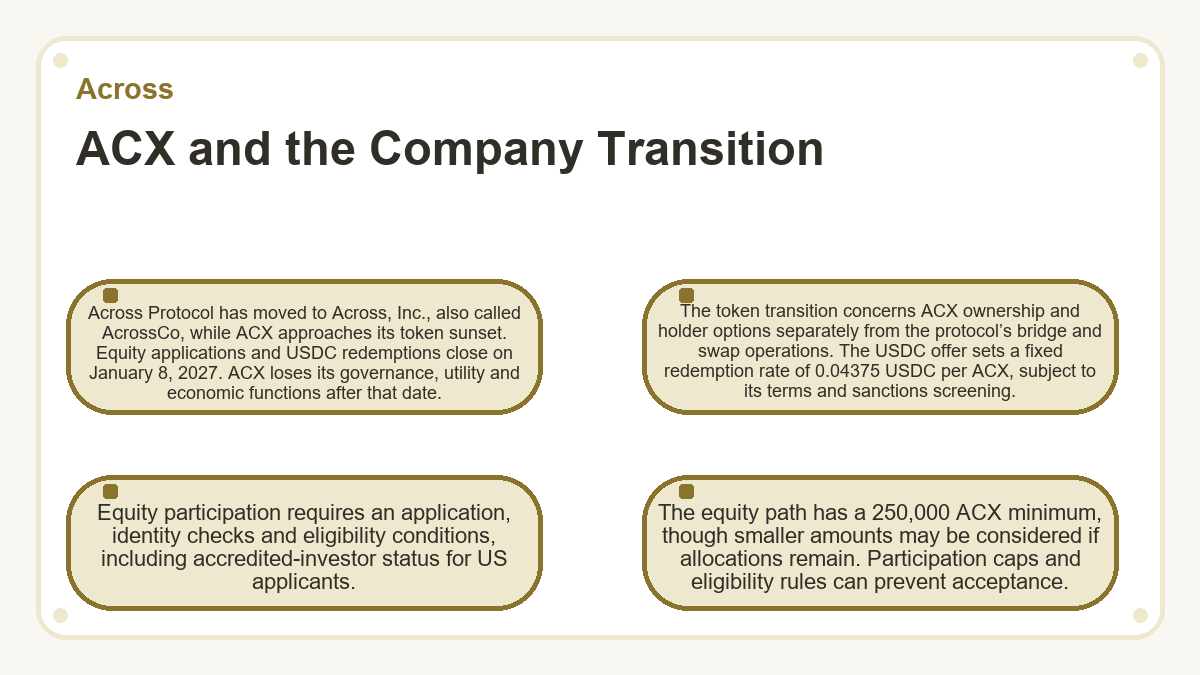
The USDC offer sets a fixed redemption rate of 0.04375 USDC per ACX, subject to its terms and sanctions screening. Equity participation requires an application, identity checks and eligibility conditions, including accredited-investor status for US applicants. The equity path has a 250,000 ACX minimum, though smaller amounts may be considered if allocations remain. Participation caps and eligibility rules can prevent acceptance.
FAQ
Can a Transfer Deliver Tokens to a Wallet Other Than the sender’s?
A Swap API transfer can specify a recipient that differs from the depositing wallet. The recipient parameter identifies the account that receives the destination output. The address must use the destination’s required format. Sending and receiving addresses have separate roles, so an integration should preserve the selected recipient when it builds the transaction.
Does Approving a Token Complete an Across Transfer?
Token approval grants spending permission and does not complete a cross-chain transfer. The standard wallet flow may require approval transactions before its main swap or bridge transaction. An existing sufficient allowance can remove that approval requirement. Approval confirmation establishes permission; the origin transaction and destination delivery remain separate events.
When Does an Unfilled Deposit Qualify for a Refund?
An intent deposit qualifies for the documented expiry refund process when its fill deadline passes without a fill and no partial fill has occurred. Expiry establishes eligibility rather than immediate repayment. Processing depends on settlement bundles, the challenge period and transmission to the refund chain, so the refund can arrive later than the fill deadline.
Where Does a cross-chain Swap Refund Arrive?
A refund follows the selected route’s refund token, chain and address settings. Swap API routes with a destination swap default to destination refunds, while routes without that destination swap default to origin refunds. An explicit refund-chain setting can change the selected behavior. For HyperCore withdrawals configured for an origin refund, funds return on HyperEVM, not to the HyperCore balance. The quote’s refund token can differ from the original input after an origin conversion, so returned funds need not match the initially submitted asset.
How Long Does a Standard Swap API Quote Remain Valid?
A standard Swap API quote remains valid until its returned quote-expiry timestamp. Fees and market conditions change, so the same inputs can produce a different replacement quote. Quote expiry limits the opportunity to submit that priced transaction; a deposited intent’s fill deadline governs a different stage. Persistent deposit addresses follow their separate amount-agnostic design.
Which Credentials Does a Production API Integration Require?
Production API integrations require an API key and an integrator ID. The key authenticates requests, while the ID identifies the application. HyperCore gasless withdrawals require swap-gasless permission on the key; deposit-address creation requires deposit-address permission. Testnet APIs do not require these production credentials.
Are Gasless Transfers Free of Bridge and Swap Charges?
Gasless submission lets a submitter pay transaction gas, which the user may reimburse through a quoted submission fee. Bridge fees, swap costs and application charges can also apply. Availability depends on the supported route and authorization method. The quote supplies the relevant cost breakdown. A separately sponsored route may waive particular fees, which is a distinct condition from gasless authorization.
What Reference Tracks a Transfer Through a Persistent Deposit Address?
The original funding transaction’s depositTxnRef identifies a transfer made through a persistent deposit address. The associated sweepTxnRef identifies the execution that moves funds from that address into the bridge. A sweep can cover multiple deposits, so its transaction reference may identify several transfer records. Funding, sweep execution and destination delivery describe different stages.
updated